
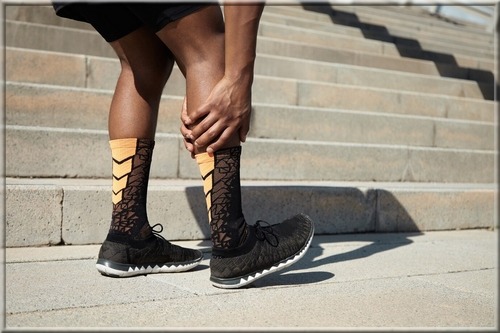
If you’re one of the millions struggling with plantar fasciitis or flat feet, you’ve probably wondered: Can the right socks actually make a difference?
The short answer: Yes but only if you choose the right ones and pair them with other treatments.
In this guide, we break down:
✔ How plantar fasciitis socks work (and when they don’t)
✔ The best socks for different needs (runners, severe pain, budget buyers)
✔ Key features to look for (compression levels, arch support, materials)
✔ Common myths and mistakes (like wearing no-show socks or skipping orthotics)
Plus, we answer burning questions like:
🔹 Do plantar fasciitis socks work without orthotics?
🔹 Are night socks worth it for morning heel pain?
🔹 What’s better for runners – compression socks or arch support sleeves?
Do plantar fasciitis socks really work to relieve pain?
Let’s cut through the hype: Plantar fasciitis socks won’t cure your condition overnight, but when chosen correctly, they can be a game-changer for pain management.
Here’s exactly how they help (and where they fall short):
How do plantar fasciitis socks help with pain relief?
– Compression (20-30 mmHg is ideal)
- Reduces inflammation by improving blood flow to damaged tissue
- Prevents fluid buildup that causes morning heel stiffness
Best for: People who stand all day or wake up with throbbing pain
– Arch support
- Stabilizes flat feet to stop overpronation (a major cause of strain)
- Some (like Podoks®) activate the Windlass mechanism – your foot’s natural arch-locking system
Best for: Runners or those with collapsed arches
– Strategic cushioning
- Gel pads or merino wool lining absorb shock in key areas (heel, ball of foot)
Best for: High-impact activities or hard-surface workers
Where they fall short
⚠️ NOT a substitute for orthotics if you have severe flat feet
⚠️ Cheap drugstore compression socks often lack proper arch zones
⚠️ No-show styles fail because they don’t control calf muscle tension
Real-world example:
A 2023 study found wearers of medical-grade compression socks had 32% less pain after 8 weeks – but ONLY when combined with daily calf stretches.
Bottom line:
They’re like a supportive brace for your foot – helpful when used as part of a full treatment plan (orthotics + stretching + good shoes), but not a standalone fix.
* Pro tip: If your socks don’t have targeted arch bands or medical-grade compression, they’re probably not doing enough heavy lifting for your plantar fasciitis.
The best plantar fasciitis socks for runners, night pain and tight budgets
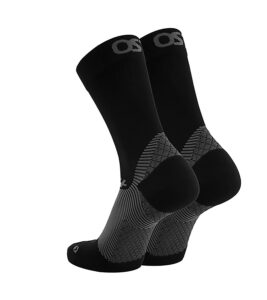
Best overall for severe pain: OS1st FS4
The OS1st FS4 is one of the most advanced plantar fasciitis and arch support socks on the market (aff).
Here’s what makes it special in just 3 key points:
1. Medical-grade targeted compression
- 20-30 mmHg pressure precisely zones in on the arch & heel (unlike generic compression socks)
- Stabilizes the plantar fascia to reduce micro-tears that cause pain
2. Biomechanical design
- Patented “Achilles Ribbon” supports the tendon to improve gait
- Seamless toe prevents blisters during long wear
3. Who it’s best for
✔ Severe heel pain sufferers needing day-long support
✔ Athletes (runners, tennis players) wanting injury prevention
✔ People who’ve tried cheaper socks without results
Real difference: These are orthotic-level socks – the closest thing to wearing arch supports and compression sleeves simultaneously.
Many physical therapists recommend them post-recovery.
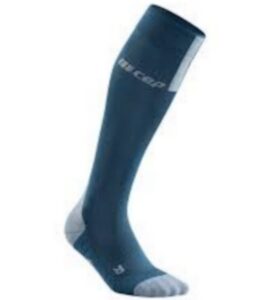
Best for runners: CEP Run Compression or Apolla compression
Why they dominate the track:
- CEP Run Compression‘s secret weapon: HEIQ® climate fabric regulates temperature + arch-specific compression (25-30mmHg) to combat lactic acid buildup mid-run (aff)
- Apolla The Performance Compression‘s edge: Cross-weave ankle support prevents rolling on uneven terrain (aff)
- Game changer: Both use medical-grade graduated compression – tightest at the arch, lighter at the calf
Ideal for: Marathon trainers & trail runners needing performance + pain prevention
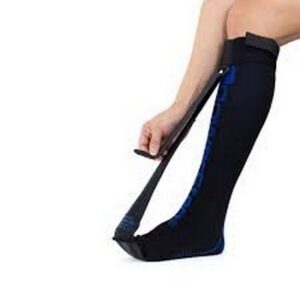
Best for night wear: PowerStep UltraStretch Night sock
Powerstep Ultrastretch, the midnight pain reliever (aff)
- Splint alternative: Gentle 15-20mmHg compression maintains the foot’s optimal 90-degree angle while you sleep
- Breathable design: Open toe prevents overheating (unlike clunky night braces)
* Pro tip: Wear 2-3 nights weekly to dramatically reduce morning heel stabbing
Ideal for: Chronic sufferers who hate traditional night splints
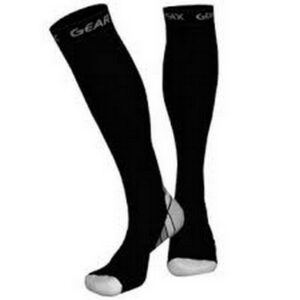
Best budget plantar fasciitis socks: Physix Gear Sport
Where savings meet smart support:
- Graduated compression: Physix Gear Sport 15-20mmHg gives 70% of premium socks’ benefits at 50% the cost (aff)
- Hidden perk: Flat-knit seams eliminate irritation points for sensitive feet
Real talk: Lacks medical-grade arch bands – best paired with $20 PowerStep insoles
Ideal for: First-timers or those needing all-day comfort without the investment
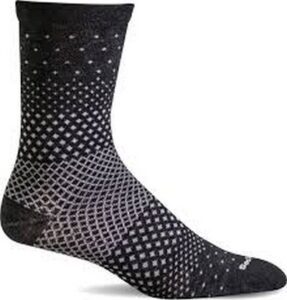
Best moisture-wicking socks for sweaty feet: Sockwell Plantar Ease
Sockwell Plantar Ease, the sweat solution (aff)
- Merino magic: 56% wool blend wicks 30% faster than synthetic athletic socks
- Strategic cushioning: 3D-knit heel cup absorbs impact on hard surfaces
- Bonus: OEKO-TEX certification means no skin-irritating chemicals
Ideal for: Nurses, hikers, or anyone clocking 10K+ daily steps
What to look for in plantar fasciitis socks: Compression, materials and fit
1. Compression level: Why 20-30 mmHg works best for heel pain
- Mild pain? 15–20 mmHg (e.g., Physix Gear Sport)
- Severe pain? 20–30 mmHg (e.g., OS1st FS4)
2. Arch support: Ribbed bands vs medical-grade zones
- Ribbed bands (PowerStep) → Good for daily wear
- Medical-grade compression zones (OS1st) → Best for severe cases
3. Materials that matter: Merino wool, silver-ion and seamless toes
- Silver-ion fabric → Fights odor
- Merino wool → Temperature regulation
- Seamless toe → Prevents blisters
4. Choosing socks for running, standing all day or sleeping
- Running? Look for ankle support + lactic acid tech (CEP Run)
- Standing all day? Prioritize cushioned heels (Sockwell)
- Night use? Go for stretchable, open-toe designs (PowerStep)
Plantar fasciitis socks: Worth it or waste of money?
Let’s be real – plantar fasciitis socks aren’t wizardry, but the right pair can be a total game-changer if you:
✔ Battle daily heel pain (especially that first-step-morning-agony)
✔ Live in running shoes or work boots (looking at you, nurses and construction crews)
✔ Want to slash recovery time after workouts
For mild to moderate cases, a quality pair will:
– Dull the knife-in-your-heel feeling (hello, targeted compression)
– Keep flare-ups in check when combined with 2-minute daily stretches
– Outsmart blisters with seamless, sweat-wicking tech
But if your arches are basically pancakes? These are your support crew – not the MVP.
You’ll still need:
➔ Orthotics (PowerStep Pinnacle for the win)
➔ Serious shoe upgrades (motion control is key)
➔ Patience (healing takes weeks, not days)
Skip the Guesswork – Grab These Fan Favorites:
► OS1st FS4 – When every step feels like stepping on Legos
► PowerStep Night Sock – For people who hate clunky night splints
► CEP Run – If you refuse to let PF bench you from races
Frequently asked questions about plantar fasciitis socks
Can I wear compression socks for plantar fasciitis all day?
Yes, you can wear medical-grade compression socks (20-30 mmHg) like the OS1st FS4 for 8-12 hours daily. However, listen to your body – if you experience tingling toes or swelling, remove them immediately. Note that nighttime socks like the PowerStep UltraStretch are specifically designed for sleep and should not be worn during the day.
Can plantar fasciitis socks be worn with orthotics?
Yes, you can layer plantar fasciitis socks with orthotics for enhanced support. For best results, put on your compression socks first, then insert your orthotics into your shoes. Avoid thick socks that may compress the arch support of your orthotics, reducing their effectiveness.
How long should I wear plantar fasciitis socks daily for best results?
For optimal pain relief, wear them for at least 4-6 hours during high-impact activities like workouts or long shifts. Those with chronic pain may benefit from 8-10 hours of daily wear. Clinical studies suggest consistent use for 6-8 weeks yields the best reduction in heel pain and inflammation.
What are the risks of wearing plantar fasciitis socks incorrectly?
Wearing the wrong size or compression level can lead to circulation issues. Signs of improper wear include numbness, blue toes, or excessive tightness. Always choose medical-grade socks (15-30 mmHg) unless a doctor recommends higher compression. Additionally, unwashed socks can harbor bacteria—wash them every 1-2 wears to prevent skin irritation.
Can plantar fasciitis socks prevent further foot damage?
While they won’t cure structural issues like bone spurs or severe flat feet, quality plantar fasciitis socks can help prevent overpronation, micro-tears in the fascia, and heel bruising. For maximum protection, pair them with supportive orthotics and daily calf stretches.

Marie – FlatFeetSolutions
Flat feet, wide feet or plantar fasciitis? Like you, I'm tired of useless advice.
On this site, I share practical solutions, shoe tests and tips based on my experience and extensive research. My goal: to help you make informed choices for more comfort in daily life.
📌 Important: My advice is informative. For any foot health problem, always consult a podiatrist.
)